Tuesday, July 16, 2013

London - Millennium Bridge/Tate Modern Museum - 6/22/2013

We've seen ancient art. Now it's time to contrast that with some modern art before the day is done. The Tate Modern is located across the River Thames and the group must cross the Millennium bridge to get there.
 Millennium Bridge
It is officially called the London Millennium Footbridge, a steel suspension pedestrian bridge that crosses the Thames and links Bankside to the city. A new structure that opened in June, 2000, the bridge seems like a fitting entrance to the Tate Modern. In fact, the bridge had a bizarre opening that could have served as inspiration for some of the 'interesting' art we were to see later at the museum. The bridge was designed to support a load of 5,000 people, with eight suspension cables tensioned to pull with a force of 2,000 tons against piers set into each bank. "Londoners nicknamed the bridge the "Wobbly Bridge" after participants in a charity walk on behalf of Save the Children to open the bridge felt an unexpected and, for some, uncomfortable swaying motion on the first two days the bridge opened." I bet the excited pedestrians didn't expect to get seasick on a bridge. Cheerio! This wasn't brilliant. The company who had won a contest to design the bridge were, I'm sure, very embarrassed. The bridge was closed for two years of modifications to eliminate the sway. It reopened in 2002. They found that the 'wobble' had something to do with "lateral frequency modes." In retrospect, I'm sure I saw that phrase on the BS written next to some of the modern art in the Tate. It's a good thing the bridge didn't wobble. Sometimes older people can suffer from incontinence, particularly on a swaying bridge. Thankfully, we crossed without incident. Hopefully, there are bathrooms at the Tate.
Tate Modern Museum
Again we decided to split the group up at the Tate and get back together in an hour or so. Anne and I decide to go see the free stuff. Our lack of interest in the special exhibits dictated that we not pay for something that could potentially (no, probably) be under appreciated. Don't get me wrong, I can appreciate some modern artists (Picasso, Lichtenstein, Calder, etc.), but when it comes to most modern art, I am either an idiot and uncultured or this is a massive joke on humanity allowing some odd, off-balance people to be passionately unproductive. We headed to the gift shop first. Maybe there is some interesting stuff in there. Usually, particularly in modern art galleries, you can view most of the art there by looking at the postcards. It's quicker, without having to read the BS posted next to the art in the gallery and trying to make sense of what you are looking at. After spending enough time in the gift shop, we still have too much time on the clock before the group meets up again. We walk upstairs and run into Manuel. He looks excitable and says, "There must be something wrong with me. I don't get this stuff. It's a bunch of crap. I've got to get out of here." Thank you Manuel! I have just received outside vindication for my opinion on the subject. But Anne and I press on. We pass an exhibit by a "sound artist" who created these "artistic" contraptions that make weird sounds. What? Then we see this sewing machine, wrapped in a blanket, with a rope tied around it. OK, I've had enough. We decided to go out to the balcony overlooking the Thames until it's time to meet up again with he group.
 Back to Petersham Place
We are back at the flat at the end of a long, eventful day of site seeing. Anne and I are responsible for dinner. We decide to walk to a small restaurant two blocks away and get pizza to go. We need to feed seven people, so we order three large pizzas. That should be enough. They hand us these small boxes and they appear to contain something not much larger than a personal pan pizza. It turns out they only had one size, large. Large is only 10 inches. London is expensive. They must have imported those ingredients from Italy. It's too late to order more, so we head back to the flat. The pizza with Manuel's always good selection of wine hit the spot. Surprisingly, this was enough to feed the group. Or was it. After a few drinks, Anne mentions gelato (surprise) and she, Wanda, and Marilyn were out the door in search of a few quarts. Successful, we ended the day on a gelato note. I'm sure Anne will fall asleep with a smile on her face as she counts different flavors of gelato jumping over a fence. Exhausted, we have another big day tomorrow. We will sleep good tonight.




London - The British Museum/The Blackfriar - 6/22/2013

We hopped on the tube, but due to the closing of part of the line, we ended up walking a good bit of the way to the British Museum.
The British Museum
The original museum was largely based on the collection of the physician and scientist, Sir Hans Sloane (1660 - 1753). A prominent physician of the time, Sloane had a number of wealthy and aristocratic patients, including Queen Anne and Kings George I and II. He was very innovative, promoting inoculation against smallpox, the use of quinine for treating malaria, and my favorite, the health giving properties of drinking chocolate mixed with milk. "He became President of the College of Physicians in 1719 and in 1729 succeeded Sir Isaac Newton as President of the Royal Society." During his lifetime he amassed an enormous collection coins, books, and natural history objects: 23,000 coins and medals; 50,000 books, prints, and manuscripts; a collection of dried plants; and many objects relating to ancient times. Upon his death at the age of 93 (the chocolate milk worked wonders), Sloane not wanting to see the collection broken up, bequeathed the entire collection to King George II in return for payment of £20,000 to his heirs. King George in turn gave his formal assent to an Act of Parliament to establish the British Museum on June 7, 1753. The museum first opened to the public on January 15, 1759 on the site of the current museum building.
Over the following two and a half centuries, the museum collection was enlarged as a direct result of the expanding British colonial empire. Caesar, upon conquering Britain in 54 BC, uttered the Latin words "veni, vidi, vici" (I came, I saw, I conquered). The British took it one step farther, "I came, I saw, I conquered, and I took everything of value I could put my hands on." These things now comprise the most incredible collection of objects of antiquity that I have ever seen. I guess they felt guilty, so admission is free.

Again we decided to break up the group with an agreement to meet again at the main entrance in two hours. Anne, Marilyn, and I decided to head to the Egyptian exhibit hall. "The British Museum houses the world's largest and most comprehensive collection of Egyptian antiquities, over 100,000 pieces, outside of the Egyptian Museum in Cairo. A collection of immense importance for its range and quality, it includes objects from virtually every site of importance in Egypt and the Sudan." Together they illustrate every aspect of the cultures of the Nile Valley from around 10,000 BC up to the 12th century AD, a time span of over 11,000 years. The first thing we happened upon was the Rosetta Stone, dated to 196 BC. This is considered the key to the decipherment of Egyptian hieroglyphs. But this was only the beginning. On display was everything from huge ancient sculptures to numerous incredibly preserved mummies and everything in between. We walked into the Middle East exhibit and viewed artifacts of Assyrian art including the Balawat Gates. "The gates measured 20 feet in height and belonged to the temple of Mamu, the god of dreams. These were made up of 13 bronze bands attached through nails to two wooden gates of the palace. The bronze bands depict a sacrifice and war scenes from the campaigns of the Neo-Assyrian king Shalmaneser III (859-824 BC)." Beautiful craftsmanship in the bronze bands. It better be or you get sacrificed.
So much to see and not enough time. All this art, war, and pillaging makes one hungry for food and a pint. The group met at the main entrance and it was off to the Blackfriar Pub on Queen Victoria Street.

Blackfriar 
It was a short walk to the Blackfriar pub for fish and chips. As with everything else in London and Europe for that matter, this place has a long history. The location got its name from the Priory of Dominicans whose monastery occupied this site from 1276 to 1539. Because the monks wore black habits, they were known as 'BlackFriars'. However, its real claim to fame, or infamy, was that this was the location in 1529 for the divorce hearing of Catherine of Aragon and Henry VIII. He attempted to persuade a delegation from Rome that his marriage was against the laws of the church. The church disagreed. Well, in Henry's mind, it was good to be the king. He dissolved the marriage, closed the monastery, told the Catholics to get lost, and started his own religion. As head of the Church of England he created a new set of rules. One was, if he didn't like his wife, he could send her to the Tower of London and have her head chopped off. It became a very bad idea to marry the king. You better give the king a son. It wasn't good enough to give him the daughter who became Elizabeth I. Ask Anne Boleyn.
Manuel, Julie, and Jane
Wanda and Ken
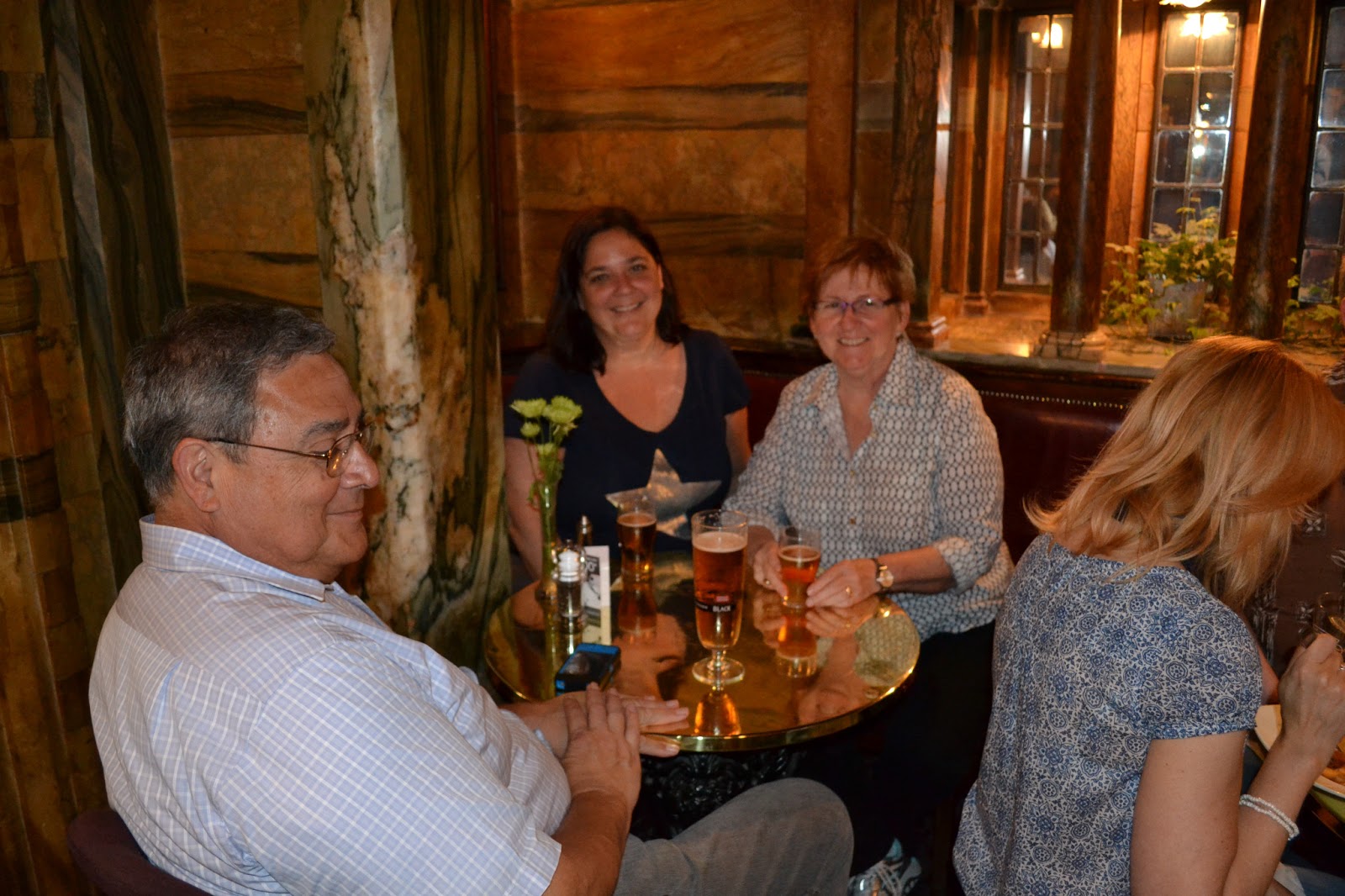
Back to June 23, 2013. We walked into this beautiful pub that was all natural wood and marble. The back room was a little claustrophobic, but the front room with the bar was bright and open. Fish, chips and a pint, thank you. One thing about the beer in Europe. It tastes great, but comes to you at room temperature. It's a little disconcerting at first, but halfway through ... I think I'll have another. You get used to it real quick. The front room had one of the most exquisite bars I have ever seen. I'm not much of an entertainer, but I think I would entertain if I had one of those in my basement. The current building was built in 1875. But the Blackfriar did not acquire its spectacular facade and interior until 1905. OK, we now have fuel to keep going. We are not done yet today. We can pass out later. Heading across the River Thames to the Tate Modern Museum.


Saturday, July 13, 2013

London - Covent Garden - 6/22/2013

It's going to be a busy day today. Couldn't sleep much. Guess I'm still recovering from the jet lag. Plans are to leave the flat at 9:30AM and head out to Covent Garden, a famous London landmark.We had coffee, a quick bite for breakfast, and hopped on the Tube at Gloucester Road.
Covent Garden
After a short walk, we entered a square, surrounded by high-end shops, St. Paul's church, and the Apple Market that contained many street vendors, street performers,
pubs, and restaurants. "The land, now called 'Covent Garden', was seized by Henry VIII, and granted to the Earls of Bedford in 1552." The 4th Earl commissioned a guy named Inigo Jones to build some up-scale houses to attract wealthy investors. Inigo Jones - sounds more like a center fielder and lead-off hitter than a 16th century Brit. Jones designed the Italiante arcaded square and the church of St. Paul's." The design of the square was new to London, and had a tremendous influence on modern town planning, acting as a prototype for new estates as London grew. However by the later part of the  17th century and well into the 18th century things began to change. Gradually, both the market that had sprung up on the south side of the square in 1654 and the surrounding area fell into disrepute as "taverns, theatres, coffee-houses, and brothels opened up; the gentry moved away, and rakes, wits, and playwrights moved in." By the 18th century, Covent Garden had become a red-light district, attracting many notable prostitutes of that era. In fact, an enterprising publisher who went by the pseudonym of 'H. Ranger' released the first edition of Harris's List of Covent Garden Ladies just in time for Christmas, 1756. "Merry Christmas, Elizabeth, I hope you like this new, brilliant, high-society book on style I got you for Christmas. Love, Reginal." Oops! Published as an annual directory from 1757 to 1795, this stylish booklet was a directory that described "the physical appearance and sexual specialties of about 120 - 190 prostitutes who worked in and around Covent Garden." From contemporary reports, it was estimated that 8000 copies of the booklet were sold annually.
Interestingly, this was not the first directory of prostitutes to be circulated in London. The Wandering Whore ran for five issues between 1660 and 1661. As opposed to Harris's List, it was meant to be an expose of the sex trade. Note the difference in the titles; I wonder what the publishers' opinions were on the subject? The Wandering Whore uses dialogue between such characters as "Magdalena, a Crafty Whore, Julietta, an Exquisite Whore, Francion, a Lascivious Gallant, and Gusman, a Pimping Hector." I love that. I can see myself trying to settle an argument by pointing to each combatant in turn and respectfully saying, "You, my good man, are an honorable man. But you, sir, are a Pimping Hector." Or the more contemporary "Get your Pimping Hector ass out of my office."
OK, I have gotten off track again. It took an Act of Parliament to clean up Covent Garden. In 1830, the famous neo-classical building was built to cover and help organize the market. The red-light district declined as the market grew and new buildings were added: the Floral Hall, Charter Market, and in 1904 the Jubilee Market. The tourist location seen today contains cafes, pubs, small shops, a craft market called the Apple Market, and another market held a Jubilee Hall.
We split up as a group and made plans to meet at a central location on the square at a specified time. Anne and I walked by the gardens behind St. Paul's and visited a number of shops on either side of the Apple Market. There were plenty of street performers providing music, comedy, juggling, etc. We were fascinated by an open air restaurant with a guy preparing vegetables to throw into giant woks to make a lunchtime Paella. But, alas, it was too early for lunch. On our first full day in London, it didn't take much to fascinate us. It was time to connect back up with the group and head to the British Museum, purported to be the most amazing museum of the many museums in London.


Tuesday, July 9, 2013

London - 6/21/2013

Petersham Place
Upon arrival Heathrow, Manuel had kindly scheduled a limo to deliver us to the residence he had rented for the week. It's a good thing because, if we had taken the Tube (subway), Anne and I would still be roaming the streets of London looking for the place. As it turns out, the house was perfectly located in the Kensington and Chelsea area within a short walking distance of Harrods and Hyde Park. Situated on a cobblestone back street, 36 Petersham Place is a quaint five bedroom row house in a series of dwellings that originally included living quarters and stables for horse and carriage.
We learned a lesson from our trip to Italy in 2009 on how to deal with jet lag. When we arrived in Rome, we attempted to forgo a nap and stay up until dinner - not a good idea. This time, Anne and I immediately took a two hour nap upon being shown our bedroom. Ken and Wanda had arrived an hour before us at noon and were already asleep. The weather was cool, the balcony window open, and we immediately fell asleep. Anxious to start seeing the sites, there is always time for a short beauty rest - OK, I'm talking about Anne again. I took a handsome rest; not withstanding the nasty rumor circulated by an unnamed person (Manuel) that I was voted by my classmates the ugliest person in the class of 1970. However, this was before extensive plastic surgery.
When we woke up, we were on the move. "Let's go get you guys an Oyster pass." What? I didn't come to London to eat oysters. I can get all the oysters I want in the states. Let's go get something English like Shepard's Pie, Yorkshire pudding, and a pint. It turns out that's what they call a multi-day pass to ride on the London Tube. When we are not walking, this is going to be our mode of travel around the city.

We bought our Oyster passes at the Gloucester Road Tube station and the group headed off on a leisurely walk to the famous Harrods department store. This place is truly amazing. Founded in 1834 by Charles Henry Harrod, it is currently owned by the Qatar Investment Authority. The store occupies a 5-acre site and has over one million square feet of selling space in over 330 departments making it the biggest department store in Europe. It has been reported that the company generated 125 million pounds of net income in 2012. The store has everything you could imagine including an entire department devoted solely to chocolate. Although this is probably one of the handful of departments I could afford to buy something in, this smorgasbord of chocolate has the potential of replacing or equaling Anne's desire for gelato. I can tell when her eyes get big and she utters, "Oh my God!" I, all of a sudden, started to feel like Willie Wonka escorting Charlie into the chocolate factory. I think I would rather be Marcello Mastroianni leading Sophia Loren into the gelato emporium. Yeah, that's it. But I digress.

It was getting late in the day and we were getting hungry. Believe it or not, a high-end grocery store was one of the departments in Harrods. Everything looks good, but we settle on beef bourguignon stew and several small pastry pies, one of which was called Moo Pie, a beef and vegetable concoction. On the way out we pass through the cosmetics department. Why is a Muslim woman in a full burka (only the eyes are visible) buying makeup? Go figure. Irony on our first day. We hit the grocery store on the way back to Petersham Place, mainly to stock up on some salad, fruit, and a lot of wine and liquor. The Moo Pie was a hit with a nice Cabernet. After food, drink, catching up, and some laughs, it was time to get some sleep in preparation for the start of our London odyssey tomorrow.


Sunday, July 7, 2013

Georgia - 6/20/2013

The adventure begins. We are getting on the airplane for a nine hour flight to London tonight. Neither Anne or I have been to the U.K. and are really looking forward to it. As usual with our international trips, part of the allure is not knowing what to expect. However, we do have some general knowledge about how things are going to go.
  • We are going to spend a week with great college friends (Manuel, Jane, their daughter Julie, Ken, Wanda, and Marilyn) in London, do lots catching up, and have plenty of laughs.
  • Manuel, our host, will have planned a great week. Another words, we will be on the move every day, all day, walk a lot, and leave London having seen almost all that it is possible to see in a week.
  • Manuel will purchase plenty of good wine.
  • We will consume more alcohol in the next ten days then we do the rest of the year. OK, maybe not Anne, but I have no doubt that I will.
  • Rules (oldest restaurant in London) next Tuesday night and a Bonnie Raitt concert at Royal Albert Hall on Thursday night - more on these events later.
  • Anne and I will rent a car at the tail end of the trip and spend a couple of days in the Cotswolds, about a two hour drive northwest of London. Neither of us are too sure about this move; renting a car that is. Maybe we'll start drinking on the plane. The Cotswolds (small towns, countryside) should be a nice counter point to London (big international city).
Off to the Atlanta airport. Manuel has arranged for a limo service to pick us up at Heathrow on the other end.

Sunday, July 5, 2009

Siena - 5/29/09

The trip for Anne and I was winding to a close. With this last day of sight-seeing within Tuscany we are driving to Siena, an ancient city about 1-1/2 hours from Florence. This turns out to be another beautiful Tuscan city with a rich history and plenty to hold our attention for an entire day. A walled city up a steep grade into the hills, we walked to the Cathedral (Duomo) complex at the center of the city.

Siena has Roman origins that date back to 70 AD. “The Roman origin accounts for the town’s emblem – a she-wolf suckling the infants Romulus and Remus. According to legend, Siena was founded by Senius, son of Remus, who was in turn the brother of Romulus, after whom Rome was named.” Artwork depicting a she-wolf suckling the young twins can be seen throughout the city. Siena did not prosper under Roman rule. It was not located on the major trade routes. It was not until the Lombards invaded the surrounding territory that Siena experienced prosperity. “Their occupation and the fact that the old Roman roads of Aurelia and the Cassia passed through areas exposed to Byzantine raids, caused the roads between the Lombards’ northern possessions and Rome to be re-routed through Siena. The inevitable consequence of this was that Siena prospered as a trading post, and the constant streams of pilgrims passing to and from Rome were to prove a valuable source of income in the centuries to come.” Charlemagne conquered Italy in the eight century - the oldest aristocratic families in Siena date their line to the Lombards’ surrender in 774. As feudal power began to disappear in the 12th century, Siena began to prosper as a major center of money lending and an important player in the wool trade. “It was during the early 1200s that the majority of the construction of the Siena Cathedral (Duomo) was completed.”

The Duomo complex consists six significant sites: the Cathedral, the Baptistry, the Crypt, the Facciatone, the Oratory of San Bernardino, and the Museo dell’Opera. The Siena Duomo is one of the world’s great examples of Italian romanesque architecture and was originally intended to be the largest cathedral of its kind. Its main façade was completed in 1380 – after the completion of the transept and the building of the east wall, money ran out and the construction of the rest of the cathedral was abandoned. We toured the six sites and again we were treated to some incredible artwork. Siena rivalled Florence in the arts throughout the 13th and 14th centuries. Some of us found the internal stairwell up to the top of the transept. It was another sunny day - beautiful overhead views of the city - just another great day in Tuscany.

Descending from the top of the Duomo, we walked down steps and narrow city streets to the Piazza del Campo, the town square, which is regarded as one of the most beautiful civic spaces in Europe. A huge open area (Palazzo Pubblico) is surrounded by a long elliptical walkway, shops, restaurants, and the Torre del Mangia, another of Siena's architectural treasures. Twice a year the piazza is famous for the Palio horse race. They throw dirt on the walkway and as is often said in rural Georgia, "let the big dog hunt". The horses and jockeys run a cutthroat race around the Piazza del Campo while the spectators get hammered on excellent inexpensive Tuscan wine. Guess what? We are hungry and thirsty again. Dog tired from a week of hiking, we decide to have lunch in Siena and head back to Il Castelluccio. We are all looking forward to a wonderful dinner cooked by our bed and breakfast hosts with the addition of an Italian singer to add even more class and ambiance to the affair.

As usual, the lunch was excellent, as was the wine and the company. It was time for my afternoon nap in the back of the van. We got back to Il Castelluccio early and retired poolside for some pre-dinner refreshments - most of us. Marilyn had been a trouper all week, holding her own with the assist of her cane, dragging her bum leg all over Tuscany. She had finally hit a wall. She didn't make it out to the pool - in fact, she didn't make it out of her shoes. She was busy staring at the back of her eyelids taking a well-deserved nap prior to our final dinner in Barbarino. Zac, Maxine, and Marilyn are also leaving tomorrow

All good things must come to an end. Sadly, it was time for our last dinner in Tuscany. But let's not be sad. Let's party! This was a fitting climax to our trip. The whole group settled down to a seven course meal, Tuscan style. It turns out our host is a trained chef. Ahh, the good life - too bad this can't last for more than a week. Adding to an already fantastic dinner was an Italian singer providing background music. She was fantastic and a real pro - so good that her music quickly became foreground music. I don't think they have it, but she could probably win Italian Idol. I don't know why they play American music everywhere you go in Italy. Hearing those love songs in Italian - Amore! She was that good. However the dinner hit another gear when Ken was invited up to the mike and we were treated to his fabulous karaoke rendition of Frank Sinatra's 'I Did it Her Way'. Before this dinner, I didn't realize what talented song stylists Ken and Wanda were. Soon the party broke into song and dance and it was almost like we were back in college. Only now, we were a bunch of old farts - but a bunch of old farts having a good time. This was what the whole week was all about - although there were some young farts sprinkled in with the old farts.

I won't bore you with tales of Saturday and Sunday, because most of it consisted of waiting for trains or planes and travel between Florence and Atlanta. Heartfelt thanks to Manuel and Jane, for without their planning, invitation and hospitality, Anne and I may never have gone on a trip like this. What makes it even better for me is that we were able to enjoy this trip with good friends. There's something unique and special about our class when we can get together after almost forty years and still enjoy each other's company. I'm sure I speak for Anne when I say we will never forget this trip - fantastic. Ciao and La Dolce Vita!

Friday, July 3, 2009

Florence - 5/28/09


It was decided we get a little extra sleep and take a late breakfast this morning - nothing planned until a tour through the Uffizi Gallery at 1PM. We all took advantage of the additional rest, a leisurely breakfast, and another beautiful morning at Il Castelluccio. We loaded up the van and headed for our inevitable battle with the Termini parking garage in Florence. We found our way in and down a winding one-lane ramp to a lower level. Oh-oh - at the bottom of the ramp the van is too tall to fit through the arch - cars behind us - how are we going to get out of this predicament? Somehow Paul got cars to back up, rerouted other vehicles - somehow Manuel backed the van back up the ramp and got it parked. This was just another small miracle in the realm of Roman Catholicism. Of course, it helped to have two ex-seminarians with us.

We headed to the area of Florence that includes the Ponte Vecchio bridge, Uffizi Gallery, and the Loggia dei Lanzi. We strolled the neighborhood and eventually congregated by the Loggia dei Lanzi. The Loggia dei Lanzi is a building on the corner of the Piazza della Signoria, and consists of three wide arches open to the street. The wide arches appealed so much to the Florentines that Michelangelo proposed that the arches should be continued all around the piazza. It looks like Michelangelo got shot down – even he had to deal with bean counters in suits/robes. The Loggia dei Lanzi contains large, beautiful mythological sculptures - Menelaus Supporting the Body of Patroclus, The Rape of the Sabine Women, Perseus, etc. According to a lot of the art I've seen on this trip, the Greeks and Romans liked to fight their wars naked. I guess they did this for an easy transition to rape and pillaging during the after-battle party.

The Uffizi Gallery is one of the most famous museums of paintings and sculpture in the world. Over more than four centuries, the history of the Uffizi collections intersected with that of the Florentine civilization. The building traces its origins back to 1560 when Cosimo I de’ Medici commissioned Giorgio Vasari to plan a large palace with two wings to house the administrative offices of the Tuscan state. Occupying the top floor of the building, the Gallery was created by Grand-duke Francesco I and subsequently populated with art by various members of the Medici family, who were great collectors of paintings and sculpture. “Its collection of primitive and Renaissance paintings comprises several universally acclaimed masterpieces of all time, including works by Giotto, Simone Martini, Piero della Francesca, Fra Angelico, Fillippo Lippi, Botticelli, Mantegna, Correggio, Leonardo da Vinci, Raphael, Michelangelo, and Caravaggio. German, Dutch, and Flemish masters are also represented with important works by Durer, Rembrandt, and Rubens.” Fantastic!


Tired from a week of non-stop walking, it was time for another Tuscan meal. The group happened upon another excellent Florentine restaurant on a side street off the beaten path. I'll have the usual - pasta, Moretti beer, Tuscan red wine, water (no gas - I have enough already, thank you), and cappuchino. It's been another great day. Time to head back to Il Castelluccio with a stop at our favorite wine store for more wine. By the time Manuel leaves Italy, he and the shop owner will be best friends. On the way back to Barbarino, Manuel needed socks, so we finally stopped at that which we had avoided all week - the outlet mall. The Barbarino Outlet Mall, this lone Tuscan tribute to American culture, was totally at odds with the rest of the region. Maybe in 7 - 8 thousand years it will be viewed as an archaeological rival to Hadrian's villa. Right now it's just a Tuscan bastard sitting off Highway 1-A.

Back at Il Castelluccio, it was a night of wine and leftovers. Wanda prepared a nice bruchetta. Ken, Zac, and I went for a walk to the stream and through the farm situated below the bed and breakfast. We were too tired to mess with the sheep. Most of us hung out at the pool after dark drinking wine and planning that state-of-the-art old folks home that is not far off in the future. A trip like this lulls one into thinking that retirement might not be too bad.